AWS Cloud Practitioner Study Guide 2026: Courses & Exam Prep
Prepare for AWS Cloud Practitioner CLF-C02 with a four-week study plan, Udemy course comparisons, free resources, and original practice questions.
You can spend your first week preparing for AWS Cloud Practitioner just choosing what to study. One tab recommends a fifteen-hour course. Another has a twenty-hour YouTube video. A Reddit thread says someone passed over the weekend. Meanwhile, you still cannot explain when a company would use EC2 instead of Lambda.
Start there: being able to explain the choice.
For AWS Certified Cloud Practitioner (CLF-C02), I would build preparation around one structured course, the official exam guide, and practice questions that explain the wrong answers. Keep a short list of concepts you confuse, and let that list decide what you study next.
If you want a paid course, my starting shortlist is Stéphane Maarek’s Cloud Practitioner course for a broad, organised introduction, or Neal Davis’s exam training if guided exercises and revision notes appeal to you. Once you have the foundations, Jon Bonso and Tutorials Dojo’s practice exams provide a separate question bank to work through.
You only need to choose one of the two full courses. The comparison below explains the differences, followed by a free route and a four-week plan.
Disclosure: the Udemy links in this guide are affiliate links. If you buy a course through one, I earn a commission at no extra cost to you. It does not change which courses I recommend, and the free route below costs nothing to follow.
Research checked on 13 September 2026. These recommendations are based on the published curricula, included materials, and their fit with the AWS exam guide. They are not claims that I personally completed every course or used them to earn a particular exam score.
In this guide: Exam facts · Udemy courses · Free resources · What to study · Four-week plan · Practice questions · Readiness checklist · FAQ
AWS Cloud Practitioner exam: the facts that matter
CLF-C02 is AWS’s foundational certification. It covers cloud vocabulary, service selection, security responsibilities, and costs. AWS positions it as a starting point for people new to cloud computing, including people in business roles. See the official certification overview.
| Detail | Current requirement |
|---|---|
| Exam code | CLF-C02 |
| Duration | 90 minutes |
| Questions | 65, with multiple-choice and multiple-response formats |
| Scoring | 50 scored questions and 15 unidentified, unscored questions |
| Passing score | 700 on a scaled range of 100–1,000 |
| Exam fee | US$100 base price; check regional pricing and applicable taxes |
| Where to take it | A Pearson VUE test centre or an online proctored appointment |
The format and fee come from AWS’s exam overview; the scoring details come from the CLF-C02 exam guide.
A score of 700 does not mean you need exactly 70% correct. AWS uses scaled scoring to account for differences between exam forms. A practice-test percentage cannot be converted directly into your eventual AWS score.
AWS lists coding, implementation, troubleshooting, and designing cloud architecture as outside this exam’s scope. Recognise what a service does and why someone would choose it, then use small exercises to make the idea stick. Source: exam scope and scoring.
Which AWS Cloud Practitioner Udemy course should you buy?
The useful comparison is between teaching formats. A long video course builds your understanding; a practice-exam pack helps you find gaps. Buying a question bank because it is cheaper than a course can be frustrating if every explanation introduces five more unfamiliar services.
| Resource | What the listing includes | Who I would choose it for |
|---|---|---|
| Stéphane Maarek: Ultimate AWS Certified Cloud Practitioner | About 14.5 hours, downloadable slides, demonstrations, and a full practice exam | Someone who wants one substantial course to organise their preparation |
| Neal Davis: AWS Certified Cloud Practitioner Exam Training | About 15 hours, guided exercises, quizzes, downloadable revision material, and a practice exam | Someone who wants exercises and condensed notes alongside lessons |
| Jon Bonso / Tutorials Dojo: Cloud Practitioner Mock Exams | A diagnostic test, full practice tests, answer explanations, and AWS reference links | Someone who has studied the material and needs to diagnose weak areas |
Features and approximate runtimes are from the linked Udemy listings, checked on 13 September 2026. Prices, course contents, and inclusion in subscriptions can change; check the offer shown in your account. The three course links above are affiliate links.
Stéphane Maarek: a straightforward choice for your main course
Maarek’s curriculum starts with cloud and IT fundamentals before moving through IAM, compute, storage, databases, and the wider exam material. The listing includes downloadable slides and a full practice exam, and shows a September 2026 update.
That combination makes it a sensible first course if you want a single sequence to follow. Use the slides for retrieval practice: close the lesson and explain the topic before checking your notes.
The practical limitation is the time commitment. Fourteen and a half hours of video will take longer once you pause, review, and answer questions. Also, one included exam gives you only one fresh full-length attempt. Save it until you have covered the syllabus.
See Maarek’s syllabus and preview lessons on Udemy.
Neal Davis: choose it for the exercises and revision materials
Davis’s course explicitly combines theory with guided practical exercises. Its listing includes section quizzes, an exam-cram component, downloadable diagrams and slides, and a 65-question practice exam. It shows an August 2026 update.
I would choose this format if service names remain abstract until you see them used, or if you want concise material to revisit in the final week. The exercises give you a natural stopping point: watch a lesson, try the task, explain what happened.
Check the lesson requirements before buying. Guided exercises in your own AWS account and a provider-supplied sandbox are different arrangements; do not assume a Udemy purchase includes a separate lab subscription. Account-based exercises also need some cost awareness, which I cover below.
See Neal Davis’s curriculum and included materials on Udemy.
Tutorials Dojo: the practice pack I would add after the course
The useful part of the Bonso/Tutorials Dojo listing is its emphasis on answer explanations and links to AWS documentation. That gives you somewhere to go when an answer still feels ambiguous.
At the time of checking, Udemy’s included-tests section lists 340 questions: a 15-question diagnostic and five 65-question tests. The description lower down gives conflicting totals. Check the included-tests section before purchasing rather than relying on the promotional description.
This is a practice resource, so I would use it after a course or equivalent free study. For each mistake, read why the other options fail and write a new example of your own. Repeating a familiar test until the score rises tells you less than answering a fresh set accurately.
Check Tutorials Dojo’s current practice-test contents on Udemy.
My recommendation for spending as little as necessary
Watch the free previews from Maarek and Davis. Choose the instructor whose explanation you find easier to follow. Study that course, use its included exam, and buy a separate practice pack only if you need more fresh questions.
If you already understand the services and mainly struggle with exam-style wording, you may get more value from practice exams than from another complete video course. If you are still looking up most of the nouns in each question, return to the lessons first.
Free AWS Cloud Practitioner resources worth using
You can put together a preparation plan without buying a Udemy course. The paid option mainly buys you a particular instructor’s structure and teaching style.
AWS Skill Builder and Cloud Practitioner Essentials
Start with AWS Cloud Practitioner Essentials, AWS’s own introductory course. If the course link redirects to a login screen, find it by name through AWS Skill Builder.
Skill Builder contains both free and subscription material. Check the access label on each item rather than assuming that everything in an exam-prep plan is free. AWS explains the available options on its digital training page.
Also use the AWS Certification Official Practice Question Set, which AWS recommends from the Cloud Practitioner preparation page. Use it to become familiar with the wording and the reasoning expected of you. A short question set is useful, but it cannot tell you everything about your readiness.
A free Cloud Practitioner course on YouTube
freeCodeCamp has a 2026 CLF-C02 certification course on YouTube. It is an option if you prefer a long-form video and are willing to organise your own revision.
Break it into topics and stop to answer questions between them. Watching a large video from beginning to end can leave you recognising explanations without being able to produce them yourself. Keep the official guide open as your checklist, especially when a video discusses a service whose name or pricing has changed.
How to use Reddit and GitHub without losing a weekend
Use r/AWSCertifications to compare study routines and ask about a specific concept you cannot resolve. Treat a “passed in two days” account as one person’s experience: their starting knowledge, time available, and previous work may be very different from yours.
For GitHub notes, check the exam code, the last substantive update, and the links behind technical claims. A recent commit could just be a README edit. Compare a small sample with current AWS documentation before making a repository your main reference.
My suggested free sequence is simple: Cloud Practitioner Essentials → the exam-guide checklist → official practice questions → targeted revision. A YouTube course can supply another explanation where you need one.
What to study for CLF-C02
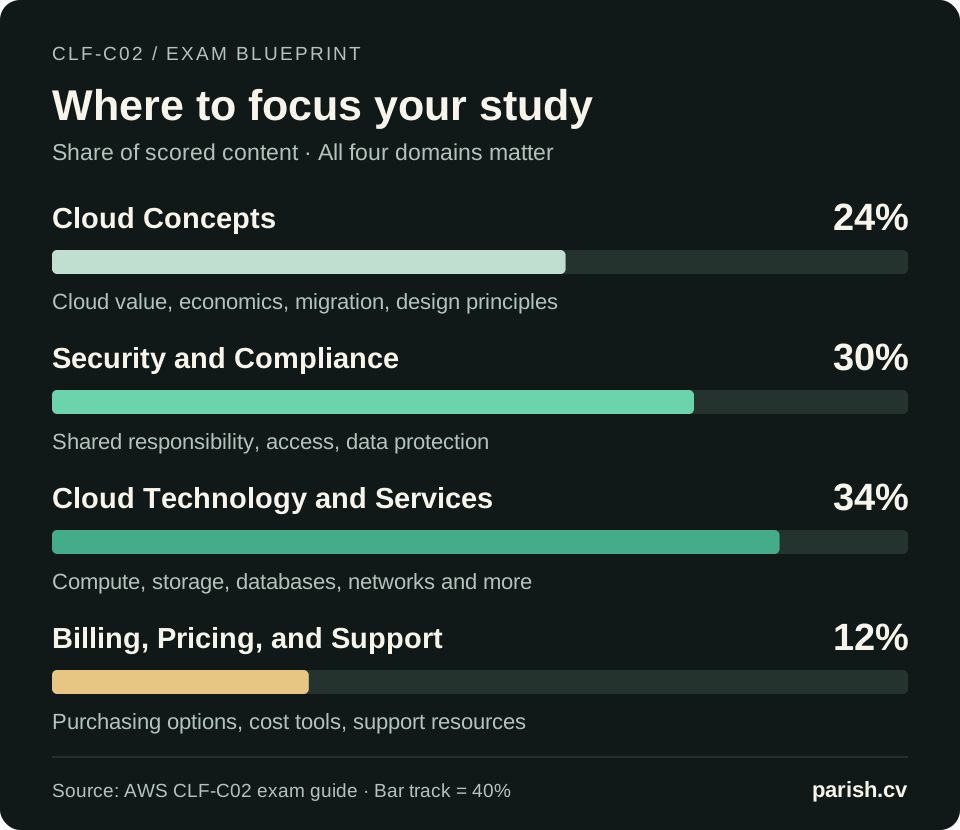
AWS publishes these weights in the domain objectives linked below. Security and services together account for 64%. Use the chart to plan coverage; it does not predict your individual questions. Open either SVG illustration to view it at full size.
Cloud Concepts: explain the business reason
Study elasticity, scalability, availability, cloud economics, migration, and the AWS Well-Architected Framework. Know its six pillars: operational excellence, security, reliability, performance efficiency, cost optimization, and sustainability. These are included in AWS’s Cloud Concepts objectives.
For a useful thought exercise, imagine a learning website that gets a large traffic spike when a new course launches. Why might changing capacity with demand be preferable to buying enough hardware for the busiest possible day? What would still need planning to keep the website available?
If you can answer in ordinary language, the vocabulary becomes easier to remember. If your answer is only “because the cloud is scalable,” keep going.
Security and Compliance: ask who is responsible
Understand IAM, least privilege, multi-factor authentication, data protection, and the difference between AWS’s responsibilities and the customer’s. Use the Security and Compliance objectives as your coverage checklist.
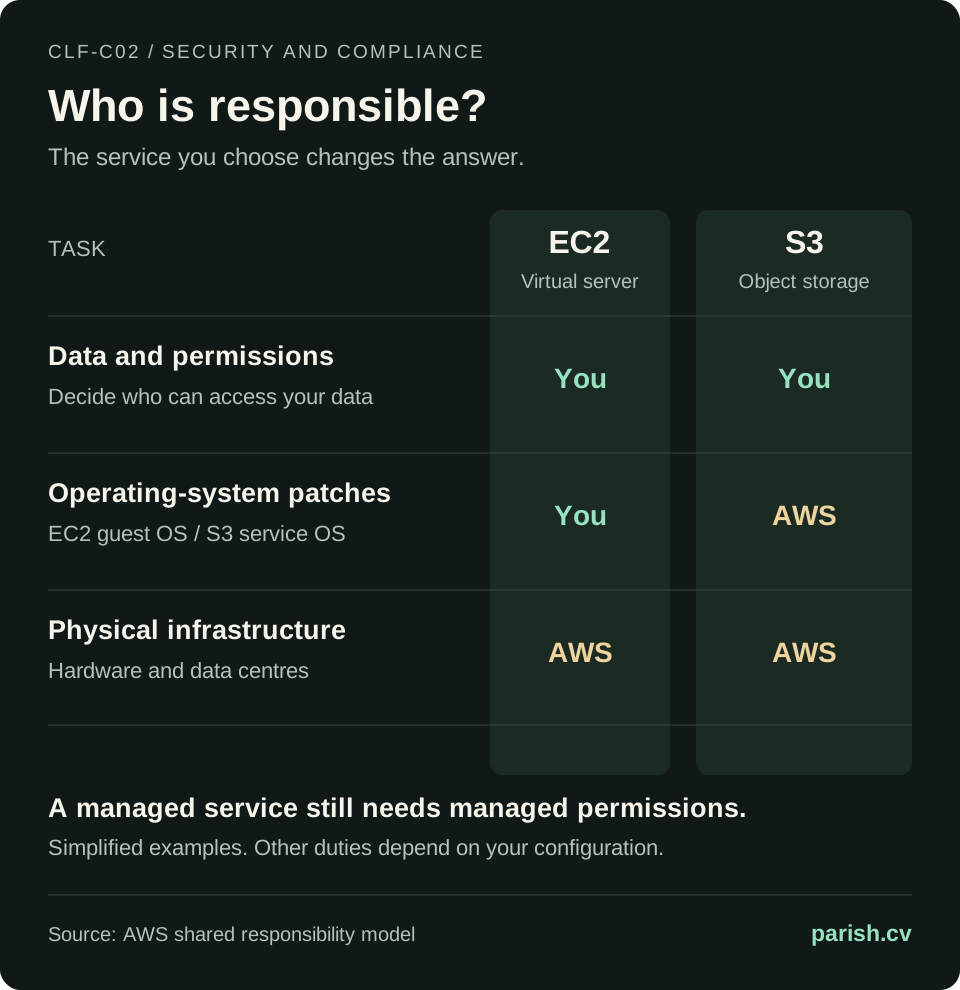
The detail to remember is that responsibility changes with the service. On EC2, you manage the guest operating system, including its patches. With S3, AWS manages the underlying operating system and service infrastructure; you still manage your data and access permissions. Moving to a managed service does not remove those customer responsibilities. Source: AWS shared responsibility model.
Turn that into a study question: “Who patches the operating system?” Your next question should be, “Which service are we talking about?”
Cloud Technology and Services: attach each name to a need
Build a small service map. Start with the categories in AWS’s technology and services objectives: compute, databases, networking, storage, analytics, AI/ML, and application integration.
For the imaginary learning website, your first notes might look like this:
| Need | Service to recognise | Distinction to remember |
|---|---|---|
| Run a virtual server | Amazon EC2 | You manage the guest operating system |
| Run event-driven functions | AWS Lambda | Serverless compute |
| Store images and downloadable files as objects | Amazon S3 | Object storage |
| Attach block storage to an EC2 instance | Amazon EBS | Block storage |
| Use a managed relational database | Amazon RDS | Relational data |
| Use a managed NoSQL database | Amazon DynamoDB | NoSQL data |
This is a starting map of services from the official objectives, not a complete architecture or the full exam syllabus.
Then learn the pairs that are easy to confuse. CloudWatch provides operational monitoring, including metrics, logs, and alarms. CloudTrail records account activity for auditing. “Alert me when CPU usage is high” and “show me who changed a resource” lead you to different tools. See the CloudWatch overview and CloudTrail overview.
Billing, Pricing, and Support: distinguish the questions
Learn the purpose of On-Demand, Spot, Reserved Instances, and Savings Plans, and the differences between Pricing Calculator, Cost Explorer, and Budgets. These are explicit Billing, Pricing, and Support objectives.
A useful way to organise your notes is by when the question arises: estimating a proposed workload, investigating costs already incurred, or receiving a notification about a spending threshold. Write one example for each tool.
A 2026 detail older guides can miss: AWS’s support plans are changing. Its support documentation lists 1 January 2027 discontinuation dates for Developer Support, Business Support, and Enterprise On-Ramp, while the current paid lineup includes Business Support+, Enterprise Support, and Unified Operations. The exam guide still contains examples using older names. Study the capabilities in the guide and compare them with the current AWS Support documentation. Neither a course’s year label nor a product announcement tells you exactly which wording you will see on your exam.
A four-week AWS Cloud Practitioner study plan
This is a suggested schedule for someone studying around an hour most days, with longer sessions available for practice exams and review. Four weeks is a planning choice, not an average completion time or a promise. If the vocabulary is entirely new, allow more time.
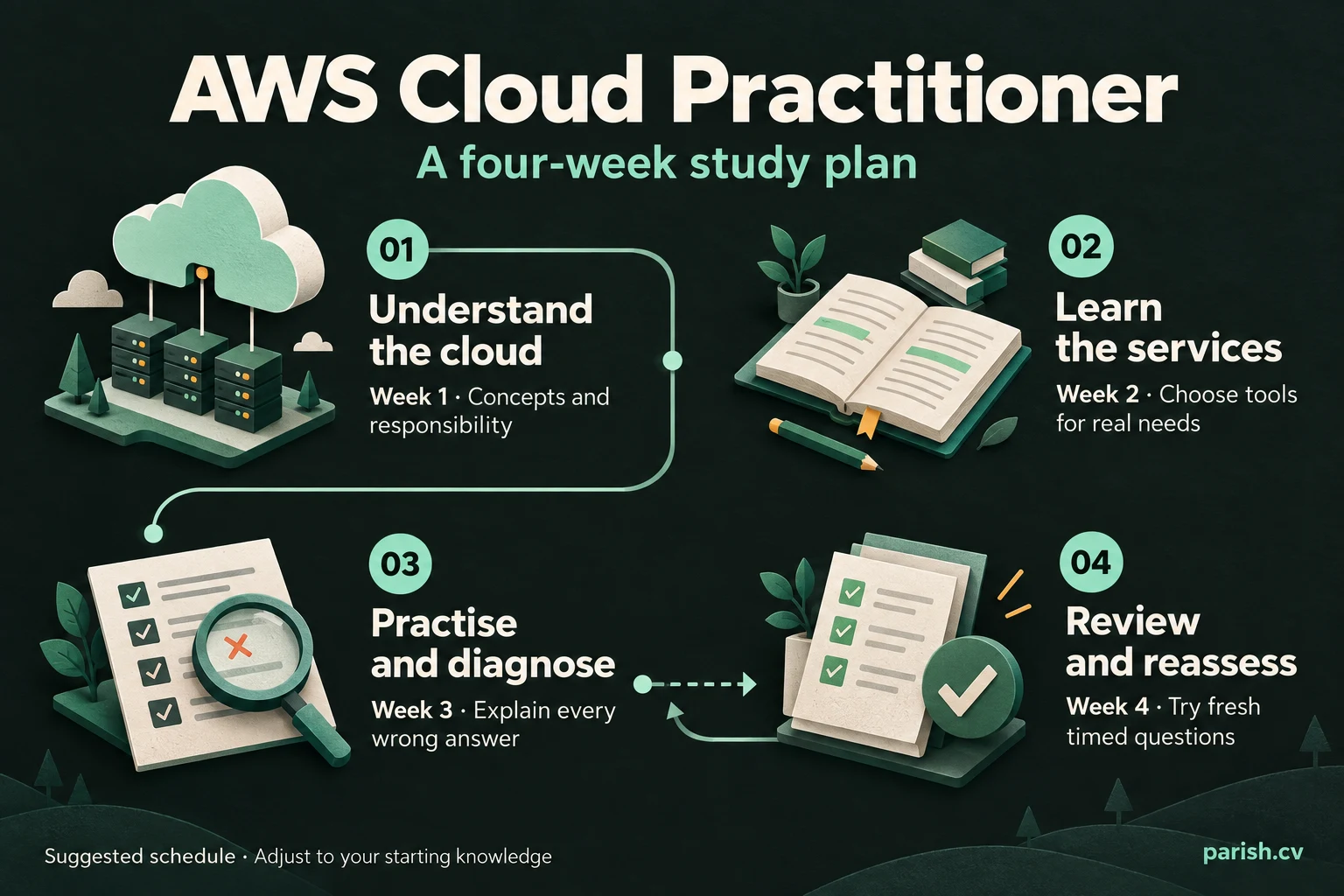
Open the illustration to view it at full size. The weekly tasks and checkpoints are also written out below.
Week 1: build a foundation you can explain
Choose your main course and work through cloud concepts, global infrastructure, IAM, and shared responsibility. Set up a notes page with two columns: “I understand this” and “I can recognise the term, but cannot explain it.”
At the end of the week, close your notes and explain these three things to someone else: why a business might choose cloud computing, what changes when demand rises, and which security work remains the customer’s job.
If you are studying in a group, take turns answering and asking follow-up questions. Explaining a topic for two minutes usually gives the group more to work with than reading slides aloud.
Week 2: connect services to examples
Work through the service categories. Add one sentence to your notes for each service: “I would consider this when…” Then write the closest service you might confuse it with and explain the difference.
Optional practical exercises can help. Follow a guided exercise that uploads a file to S3 or demonstrates an IAM permission. Keep the exercise small enough that you can explain each step, and follow the cleanup instructions afterwards.
Before using your own AWS account, read the current Free Tier terms. Eligibility and account plans differ, so an older video’s cost assumptions may not apply to you. Set appropriate budget notifications, but remember that AWS warns notifications can arrive after charges accrue. A budget alert alone does not cap spending.
Week 3: finish the syllabus and diagnose mistakes
Cover billing and support, then attempt a fresh timed practice exam. Give yourself a separate session to review it; the explanation work is part of the study time.
Keep a mistake log with four fields:
| Question topic | Why I missed it | Rule in my own words | Next review |
|---|---|---|---|
| Shared responsibility | I forgot the question specified EC2 | For EC2, the guest OS is my responsibility | Revisit the service comparison tomorrow |
| Monitoring versus auditing | I focused on the word “activity” | First decide whether the question needs operational metrics or an audit record | Write one example for each service |
| Exam wording | I missed “choose two” | Check the required number of answers before selecting | Practise reading the next set carefully |
Record guesses that happened to be correct, too. They are useful evidence of what to revisit.
Week 4: revise the gaps and reassess
Work from the mistake log. If your errors cluster around a few services, compare those services side by side. If they spread across an entire domain, return to its lessons.
Try another fresh timed set after revising. Before reading each explanation, say why you chose your answer and why the closest alternative is wrong. Use the readiness checklist below to decide whether to book, keep the appointment, or leave yourself more study time.
Allow time for the official testing requirements as well. Check your identification, booking details, and the instructions for your chosen delivery method; online candidates should complete the required system checks.
Three original practice questions to check your reasoning
These are teaching examples written for this guide, not recalled AWS exam questions. Try answering before opening each explanation.
1. Who patches the server?
A company runs its own application on an Amazon EC2 instance. Who is responsible for security updates to the instance’s guest operating system?
- A. AWS, because the server is in an AWS data centre
- B. The customer running the instance
- C. The organisation that provides the customer’s internet connection
- D. AWS, once the customer enables a budget alert
Show answer and explanation
Answer: B. The relevant detail is the EC2 guest operating system. Its updates belong to the customer. AWS manages the underlying physical infrastructure. Network providers and budget alerts do not change that responsibility. Compare this with S3, where AWS manages the service operating system. AWS shared responsibility reference.
2. Which tool answers the audit question?
An administrator needs to investigate which identity made an API request that changed an AWS resource. Which service is the best starting point for the activity record?
- A. Amazon CloudWatch metrics
- B. AWS Pricing Calculator
- C. AWS CloudTrail
- D. Amazon Route 53
Show answer and explanation
Answer: C. CloudTrail records account activity, including API activity and identity information. The question asks for an audit record of an action. CPU metrics or a cost estimate would not supply that record. AWS CloudTrail reference.
3. What does a budget notification do?
A learner wants an email when AWS spending exceeds a chosen threshold. Which option directly addresses that need?
- A. Create an AWS Budget with an actual-cost notification
- B. Add a cost estimate to AWS Pricing Calculator
- C. Open the AWS service catalogue
- D. Change the account’s display name
Show answer and explanation
Answer: A. AWS Budgets can notify you when actual or forecasted spending crosses a configured threshold. An estimate does not monitor actual usage. The notification can be delayed, so this setup should not be treated as an automatic spending limit. AWS Budgets documentation.
How to tell whether you are ready for the exam
A course-completion badge measures how much content you finished. To judge understanding, I would use these checks:
- You can explain every task statement in the official guide, or identify the specific ones that still need revision.
- You can choose between commonly confused services and explain the deciding detail.
- You can complete fresh practice tests under the time limit, with time left to revisit uncertain answers.
- Your results remain reasonably consistent across fresh sets; they do not depend on remembering questions.
- You have reviewed both wrong answers and lucky guesses.
As a personal study target, I would aim for at least 85% on two fresh, timed practice exams, with explanations I can defend. That is a conservative preparation heuristic, not an AWS requirement, a conversion to a scaled score, or a guaranteed pass. Practice providers differ in difficulty, and two strong scores can still hide a topic you have barely studied.
If you need more fresh questions at this stage, check the Tutorials Dojo practice pack. If the explanations still feel unfamiliar, revisit the relevant course sections before spending money on another pack.
Frequently asked questions
Can I pass AWS Cloud Practitioner with free resources?
Free resources can cover the material, and buying a course is not a prerequisite. Start with AWS’s introductory training, the exam guide, and official practice questions. What matters is whether you can apply the concepts to unfamiliar questions. Free preparation also does not mean the certification exam itself is free.
How long should I study for CLF-C02?
Use the four-week plan as a starting schedule, then adjust it after your first fresh practice exam. Someone already working with cloud services may need a narrower review; a beginner may need several extra weeks. Finishing fifteen hours of video and being ready to sit the exam are separate milestones.
Is Stéphane Maarek’s course enough?
Its published curriculum and included exam make it a reasonable main resource. I would still check your coverage against the official guide and assess how you handle fresh questions. You do not automatically need another full course; targeted revision or a separate practice pack may address the gap more directly.
Do I need an AWS account or coding experience?
You can begin with conceptual lessons and demonstrations. A course may ask for an AWS account for its hands-on exercises, so check the requirements before enrolling. Decide whether you want that practical component when choosing your main course.
Is Cloud Practitioner worth it for a developer?
It can be useful if AWS vocabulary, responsibilities, and billing are new to you. An experienced AWS developer may get less value from the preparation and prefer a certification closer to their work. AWS does not require you to earn Cloud Practitioner before attempting another certification. See the AWS Certification FAQs.
For a job search, think of this certificate as evidence of foundational knowledge. You will still need examples of the work you can do: a small deployment you can explain, a sensible permission model, or a clear account of a technical decision.
Can students take the AWS Cloud Practitioner exam for free?
The standard exam has a fee. If a school, employer, or training programme offers a voucher, check its eligibility, expiry date, and whether it covers the whole fee before booking. Free AWS training or student status alone should not be treated as confirmation of a free exam appointment.
What should I do first today?
Open the official exam guide, then choose your main learning resource. For paid preparation, compare the previews for Maarek and Davis. For a free start, open Cloud Practitioner Essentials.
Finish one topic. Close the lesson. Explain it in your own words. Your first useful revision note is the part you could not explain.